Thursday, July 18, 2019

The Murmur's are true


During Lee's last appointment on 7/15 we learned Lee has a heart murmur.  I cannot remember that he has ever been told this before.  Here is some info about heart murmurs from WebMD.
The "murmur" is the sound of blood flowing. It may be passing through a problem heart valve,  Or it may be that a condition makes your heart beat faster and forces your heart to handle more blood quicker than normal. Most are innocent and don't require any treatment. Some people are born with valve problems. Others get them as a part of aging or from other heart problems. Common conditions can make your heart beat faster and lead to heart murmurs. They can happen if you're pregnant, or if you have: Anemia, High blood pressure, Overactive Thyroid or Fever.
It is felt that Lee has a murmur because of his chronic anemia and is benign.  Lee usually runs quite low on his blood counts and needs blood every couple of months. 

I found a link that has heart murmur sounds audio:

https://soundcloud.com/sensicardiac/vsd-pulmonary

There is nothing that we need to do for Lee's murmur the doctors will continue to watch it and make sure it is stable.  We hope that it will resolve on its own with the liver transplant and the anemia issues that are associated with it.  


Monday, July 15, 2019

Just another appointment


Lee had another appointment with the liver team today.  He seems to be doing alright.  Dr.Gilroy is ordering a MRI to be sure that Lee does not have any blood clots and to be sure the TIPS procedure is still functioning correctly.  Liver disease can cause blood clots in the liver. All in all fairly uneventful  Lee did get his labs drawn for a new MELD score. It is now a 19 unfortunately that is lower from the last score of 21.  Lee's coordinator told us that Lee is talked about in every IDT (interdisciplinary team) and the surgeons are hoping to get Lee a liver soon and he is listed to accept a hepatitis liver.  Following is exerts I found in the Salt Lake Tribune "Hepatitis C is a liver infection that can become a long-term, chronic infection. The Centers for Disease Control and Prevention estimates that between 2.7 million and 3.9 million people in the U.S. have chronic hepatitis C. However,  Dr. Gilroy said, 98 percent of people can be cured of the infection. It also could mean an additional 600 livers available each year, Gilroy said. And that's a big deal: about 12,000 people are added to the wait list every year, but only 7,000 are taken off, according to an Intermountain news release.This creates a supply-and-demand disparity that results in about 1,500 people dying each year while waiting for a donated liver to become available for transplant," the release stated. Gilroy isn't sure if other places around the country are doing these kinds of transplants, but said Intermountain physicians are paying close attention to how these two patients react to the transplants."  https://archive.sltrib.com/article.php?id=4704667&itype=CMSID

After we came home I took our Sadie girl for a walk although it was hot outside one area where we walk has a large shade area at that time of day.  I think our girl misses her yard he enjoyed laying in the shady grass.


Friday, July 12, 2019

Clinical trial for a new organ transport system

We recently received a call about a new organ transport system that Lee's doctor had submitted his name for the trial.  Below is the power-point that we were sent for education on the new device.


 Lee and I talked this over and weighed our options we both feel that this could benefit him more then hurt so he has opted to be part of the clinical trial. 

Received a message from Krystal

Yesterday I received a message from Krystal the lady that I work with that was completing testing to be a living donor.  Unfortunately her anatomy was to different from Lee's for them to be a good match.  It is disappointing but maybe she will be able to donate to someone else in need.

I will still follow her journey, I have a link to her blog attached to ours and here is the link in case you want to follow her journey also.

https://kristalsjourney.blogspot.com/


Wednesday, July 10, 2019

Just a story I wanted to share and save.

I recently wrote a post about living donors. Today I came across a story of a lovely young lady that has been a living donor not once but twice.  What a blessing she has been to two people that she had never met before.  My hope is to spread awareness of organ donation either living or at death and the great need for organs. Please take time to read the story the link is below. 

https://www.uchealth.org/today/living-donor-when-you-have-something-to-give/?fbclid=IwAR0olt4FvsqPopzkHAmTOQewidQuGNBDoud0tClLOxjH9TNGD-4Csgu-J8A

Tuesday, July 9, 2019

Stand By again


Last night (about midnight) we were getting ready for bed and received a call that Lee was on stand by for a liver, he was the first back up and would receive a call mid morning to let us know if the liver was placed or if it was Lees.  We went to bed and had a restless night wondering if we would be heading to Murray in the morning for surgery or if it will be wait longer. This morning we received a call that said the liver had been placed. So that means Lee will be waiting for a while longer. 

UNOS

How organ matching works

When a transplant hospital accepts a person as a transplant candidate, it enters medical data—information such as the person’s blood type and medical urgency and the location of the transplant hospital—about that candidate into UNOS’ computerized network. When an organ procurement organization gets consent for an organ donor, it also enters medical data—information such as the donor’s blood type and body size and the location of the donor hospital—into UNOS’ network.
Using the combination of donor and candidate information, the UNOS computer system generates a “match run,” a rank-order list of candidates to be offered each organ. This match is unique to each donor and each organ. The candidates who will appear highest in the ranking are those who are in most urgent need of the transplant, and/or those most likely to have the best chance of survival if transplanted.
The UNOS Organ Center helps place donated organs for transplantation 24 hours a day, 365 days a year.
Below is the MELD score calculator Lee's current listed MELD is a 21. 
To determine your MELD score, please complete the form below.
Point of information This calculator is recommended for ages 12 and older.
Point of information All fields are required.

...


Dialysis TwiceHad dialysis twice, or 24 hours of CVVHD, within a week prior to the serum creatinine test?
 
Note: Creatinine will default to 4 mg/dl with a positive response.
Reset 

Saturday, June 29, 2019

Let't talk about living donors


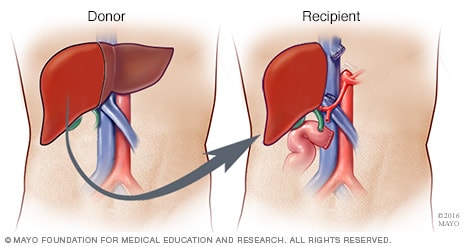
Intermountain  healthcare has a wonderful living donor program.  Healthy donors can donate a portion of their liver to a liver failure patient and this greatly decreases wait times for patients on the transplant lists.  https://intermountainhealthcare.org/services/transplant-services/become-donor/ this is a link to the Intermountain healthcare living donor web page.  Here also the link to the UNOS web page for donation there is a ton of information on this page. https://transplantliving.org/before-the-transplant/frequently-asked-questions/  .There are two lobes in every liver the right lobe is removed from a healthy donor and transplanted into the recipient.

Image result for living liver donor
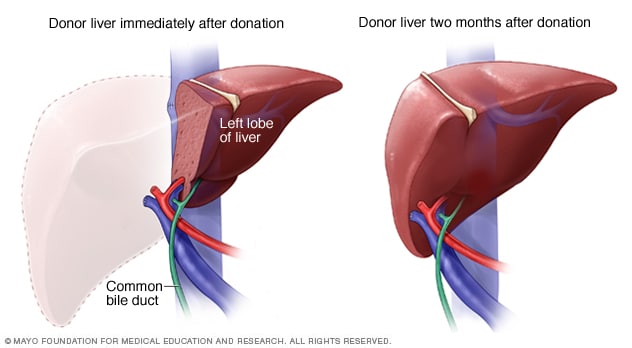
Both halves of the liver regenerate becoming the size that each person needs. Our bodies are amazing.
Image result for liver donor regeneration

A while back a lovely lady named Krystal that I work with asked me what the process and compatibility for liver donations are.  We talked for a while and she said she wanted to check into the process to be a  living donor liver for Lee.  I was blown away at the idea.  Krystal explained to me that she has always been a giver and donates blood as often as she can and a while back wanted to be a living donor for a kidney but did not qualify because she has a history of a kidney stone.  A couple of weeks ago Krystal met with the living donor coordinator and went through the first stages of testing which includes a fibroscan and blood work. 

About FibroScan


FibroScan is a specialized ultrasound machine for your liver. It measures fibrosis (scarring) and steatosis (fatty change) in your liver. Fatty change is when fat builds up in your liver cells.
FibroScan will help your healthcare provider learn more about your liver disease. It can be used alone or with other tests (such as blood tests, imaging scans, or biopsies) that also measure scarring or fatty change in your liver.

Krystal's next step will be a CAT scan to evaluate her liver.  She really likes the living donor coordinator and has learned all about the living donor program.  I am forever grateful there are such loving and caring people in the world that would give so much of themselves to save someone they do not even know. 
Krystal has started a blog of her own if you would like to follow her journey through this process here is a link to her blog.  https://kristalsjourney.blogspot.com/